

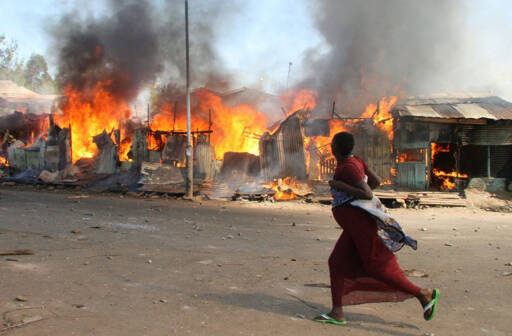
A resident runs past burning buildings during Kenya’s post-election violence in January 2008. The disputed presidential result of 30 December 2007 triggered protests that quickly spread beyond Nairobi into Kisumu, Eldoret and the Rift Valley.
Credit: AFP via Getty Images
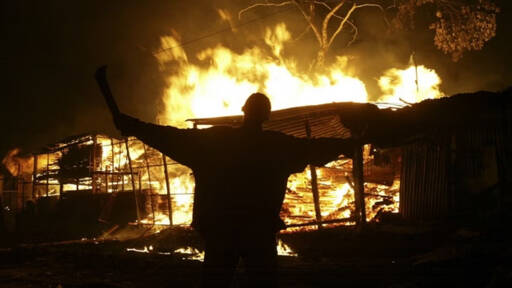
A man stands before a burning building during the 2007/08 post-election violence. The Waki Commission later recorded 1,133 deaths and found that police gunfire accounted for a substantial share of the fatalities.
Credit: Human Rights Watch
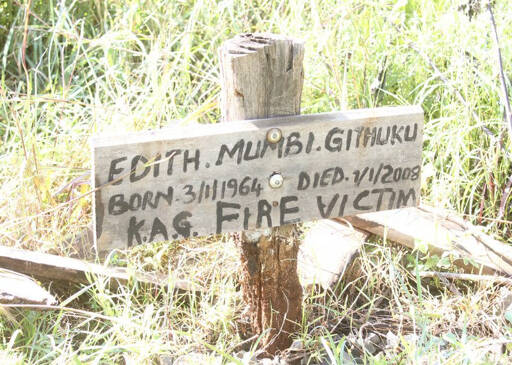
A wooden cross marks the grave of Edith Mumbi Githuku, who died in the Kenya Assemblies of God church fire at Kiambaa, near Eldoret, on 1 January 2008. The attack became one of the defining atrocities of the crisis.
Credit: Amnesty International
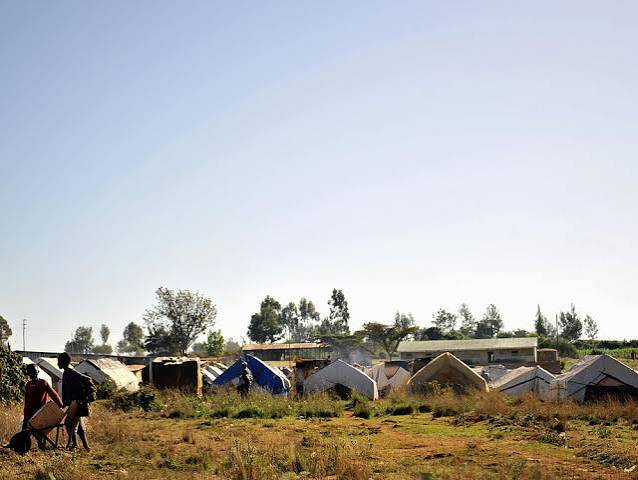
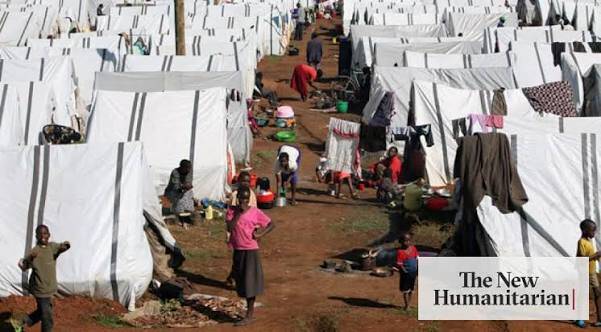
Families displaced by the violence gather at a camp in Eldoret in 2008. More than 600,000 people were displaced during the post-election crisis, according to estimates cited by the Waki Commission and human-rights organisations.
Credit: NPR

Mourners lower coffins into graves during a mass burial after the 2007/08 post-election violence. For many families, the absence of prosecutions and convictions has left the question of accountability unresolved.
Credit: TIME
From the Ashes: Kenya’s Unfinished Reckoning With the 2007/08 Violence
By: Arap Cheruiyot Adrian Kenduiwo
"Nineteen years after Kenya’s disputed election ignited one of the worst crises in its history, the country has avoided a repeat on that scale. But the peace that followed was never the same as justice."
In the final days of December 2007, Kenya was waiting for an election result that many citizens already feared would not be accepted.
The vote had been closely contested between incumbent President Mwai Kibaki and Raila Odinga, leader of the Orange Democratic Movement. When the Electoral Commission of Kenya declared Kibaki the winner on 30 December, Odinga’s supporters rejected the result as fraudulent. Within hours, protests spread from Nairobi’s informal settlements to Kisumu, Eldoret and towns across the Rift Valley.
What began as political anger became a national emergency.
Over the following weeks, more than 1,100 people were killed, according to the Commission of Inquiry into the Post-Election Violence, better known as the Waki Commission. More than 600,000 people were displaced. Homes, businesses, churches and public institutions were burned; families were forced from neighbourhoods they had inhabited for generations.
The violence did not emerge from ethnicity alone. It exposed a political system in which electoral defeat could mean exclusion from power, patronage and resources—and in which politicians could mobilise communities around fear, land and historical grievance.
A result Kenya did not accept
Kibaki was sworn in at State House on 30 December 2007, hours after the disputed announcement. The speed of the ceremony deepened suspicions among Odinga supporters that the result had been imposed rather than freely determined.
Protests began almost immediately.
In Kibera and Mathare in Nairobi, as well as in Kisumu, Eldoret, Nakuru, Naivasha and parts of the Rift Valley, demonstrators erected burning roadblocks, clashed with police and attacked homes and businesses. The violence rapidly acquired an ethnic dimension: communities associated with rival political camps became targets, and local disputes over land, property and belonging were pulled into a national political confrontation.
The Waki Commission later documented the scale of the killings and found that police gunfire accounted for a substantial share of deaths. Its report recorded 1,133 deaths, while also documenting sexual violence, arson, looting and mass displacement.
For many Kenyans, the crisis was not simply an election dispute. It was proof that the country’s democratic institutions could fail at the moment they mattered most.
Kiambaa: the violence becomes intimate
No single event captured the horror of those weeks more starkly than the attack on the Kenya Assemblies of God church at Kiambaa, near Eldoret, on 1 January 2008.
Dozens of people, many of them women and children from the Kikuyu community, had taken refuge in the church as violence spread through the surrounding area. A mob set the building on fire. The Waki Commission reported that 17 people were burned alive inside the church, while 11 others died at or on the way to Moi Teaching and Referral Hospital; the commission’s accounting of the incident also recorded further deaths connected to the attack.
The image of a church—supposed to be a place of refuge—become a site of mass killing became one of the defining symbols of the crisis.
Similar attacks were reported in Burnt Forest, Naivasha, Nakuru and Nairobi’s informal settlements. In each place, the violence followed a familiar pattern: political rivalry, local grievance, rumour, fear and retaliation feeding one another until ordinary neighbours became enemies.
The human cost
The numbers alone cannot convey the disruption.
The Waki Commission recorded 1,133 deaths. Estimates of displacement vary, but the commission and later human-rights reporting put the figure at more than 600,000 people.
Displaced families crowded into churches, police stations, schools and temporary camps across the Rift Valley and urban centres. Some lost homes, shops, farms or livestock. Others lost relatives. Many never returned to the communities from which they fled.
The violence also left a lasting institutional wound. Survivors and victims’ families repeatedly complained that investigations were slow, witnesses were intimidated, and few perpetrators were prosecuted in Kenyan courts.
That failure became one of the crisis’s most consequential legacies.
The settlement that ended the killing
As the violence intensified, international mediators led by former United Nations Secretary-General Kofi Annan pushed Kenya’s rival political leaders toward a settlement.
In late February 2008, Kibaki and Odinga signed a power-sharing agreement. Kibaki remained president; Odinga became prime minister in a coalition government. The arrangement helped bring the worst of the violence to an end.
But it did not resolve the dispute over the election, nor did it deliver accountability for the atrocities committed during the crisis.
The Waki Commission recommended the creation of a special tribunal to prosecute those responsible. It also handed a sealed list of suspected perpetrators to Annan, warning that the names would be forwarded to the International Criminal Court if Kenya failed to establish a credible domestic process.
Kenya did not create the tribunal.
The ICC eventually opened cases against six Kenyans. But the prosecutions did not produce convictions. Charges against Uhuru Kenyatta were withdrawn in 2014–15, and in 2016 judges terminated the case against William Ruto and former radio executive Joshua arap Sang after finding insufficient evidence to proceed.
For victims’ groups and human-rights organisations, the outcome was a profound failure of justice. For Kenya’s political class, it demonstrated that even allegations involving the country’s most powerful figures could end without a domestic conviction or an international one.
What changed—and what did not
The crisis did force political reform.
The 2010 Constitution, adopted after a referendum, introduced devolution, expanded rights protections and sought to limit the concentration of presidential power. Devolution was implemented from 2013 through 47 county governments, giving regions greater control over local services and development.
Those reforms were intended to reduce the winner-takes-all character of national politics that had made electoral defeat so dangerous.
Yet the underlying problems did not disappear.
Land grievances persisted. Political competition remained ethnically charged in many areas. Impunity remained a central grievance for victims. And subsequent elections continued to expose how fragile public trust in institutions could be.
Devolution changed the architecture of Kenyan politics, but it did not automatically create accountable local government, resolve historical land disputes, or guarantee that political losers would accept defeat.
The myth of easy unity
It is tempting to describe Kenya’s recovery as a national act of reconciliation: a country that looked into the abyss and chose unity.
That story contains truth, but it is incomplete.
Kenya did avoid a repeat of the 2007/08 scale of violence. Civil society, journalists, religious leaders, local peace committees and ordinary citizens played important roles in preventing escalation during later electoral cycles. A younger generation has also grown up with a constitution that promises rights, representation and devolved power.
But peace was not simply chosen. It was negotiated, enforced, purchased through political compromise, and sustained by the memory of what failure had cost.
The people who lost homes, relatives and livelihoods did not all receive justice. The political figures implicated in organising or financing violence were not convicted. The grievances that helped make the crisis possible were not fully resolved.
The shadow remains
Nineteen years later, the images remain familiar: burning tyres, families fleeing with whatever they could carry, displaced children in temporary camps, and the blackened ruins of a church near Eldoret.
They are reminders that Kenya’s democracy is not self-sustaining. It depends on institutions that citizens trust, politicians who accept defeat, police who protect rather than target civilians, and a political culture that does not treat ethnicity as a weapon.
The 2007/08 post-election violence was not only a tragedy. It was a warning.
Kenya stepped back from the brink. But the country has not yet fully answered the question the crisis exposed: whether its unity is a durable national achievement—or merely a pause between elections.
Add comment
Comments