

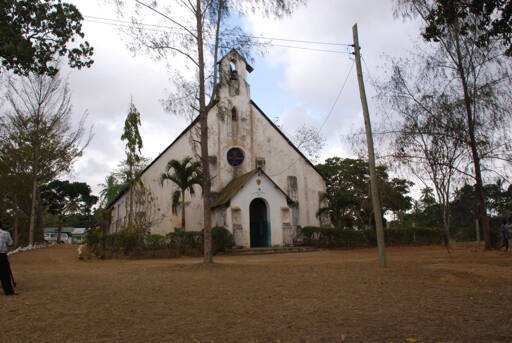
St Paul’s Church at Rabai, Kenya, was built by Church Missionary Society missionaries Johann Ludwig Krapf and Johannes Rebmann. Completed in 1846, it became the first Western Christian church in Kenya and the centre of the Rabai mission.
Credit: National Museums of Kenya / Rabai Museum.
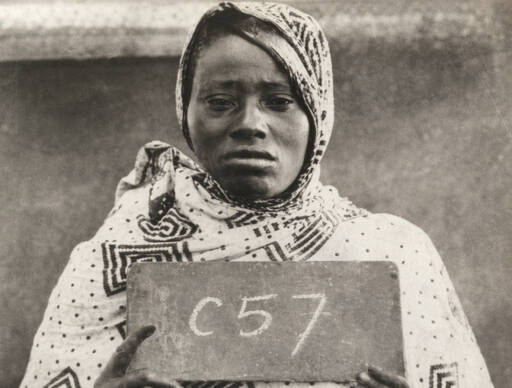
Mekatilili wa Menza, a Giriama freedom fighter and spiritual leader, mobilised her people against British colonial rule during the Giriama uprising of 1913–1914. She defended Giriama land, sacred kaya forests, and traditional institutions against forced labour, taxation, and cultural suppression.
Credit: Historical photograph, public archival image
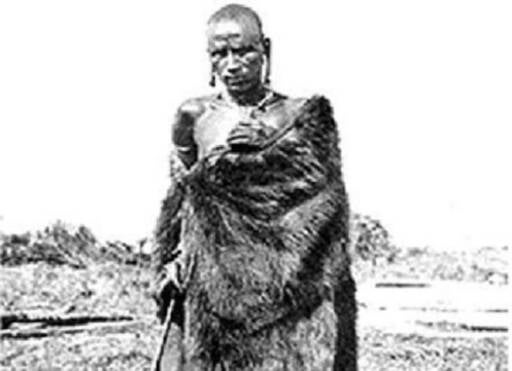
Koitalel arap Samoei, the Orkoiyot or spiritual-political leader of the Nandi, led sustained resistance against British colonial expansion between 1895 and 1905. He was assassinated in 1905 after being lured to a meeting under a white flag of truce.
Credit: Historical photograph, public archival image
The Gospel Arrived With the Gun: Religion, Land, and Power in Colonial Kenya
By: Arap Cheruiyot Adrian Kenduiwo
The missionary at Rabai
In 1844, Johann Ludwig Krapf arrived on the East African coast carrying a Bible, a missionary’s conviction, and the authority of the Church Missionary Society. Two years later, he and fellow missionary Johannes Rebmann built St Paul’s Church at Rabai, the first Western Christian church in Kenya.
Rabai is still celebrated as the place where Christianity and modern learning began in Kenya. But that familiar story leaves out a harder question: what did Africans lose when missionaries arrived alongside the colonial world that followed them?
Krapf did not bring religion to Kenya. He brought a particular European missionary form of Christianity into a region where Mijikenda communities already had their own spiritual systems, and where Islam had been part of coastal life for centuries. The deeper question is not whether Krapf was sincere. He probably was. The question is what happened when missionaries, colonial officers, settlers, and land companies began operating within the same political system.
Africa was never spiritually empty
Africa was never spiritually empty. Long before European missionaries arrived, African communities had developed complex spiritual systems that explained creation, life, death, illness, fertility, morality, justice, and the relationship between human beings, nature, and the divine. These were not vague or primitive beliefs. They were complete worldviews, passed down through oral tradition, ritual, initiation, music, proverbs, sacred places, and communal responsibility.
African traditional religions were not one single religion. They differed from one community to another, but many shared important ideas. People believed in a supreme creator, spiritual forces, ancestors, sacred land, diviners, healers, elders, and rituals connected to birth, marriage, death, harvest, conflict, and healing. Ancestors were especially important because they were seen as mediators between the living and the spiritual world. Shrines and altars were often built in their honour, and people sought their guidance, protection, and power.
Among the Agĩkũyū of Kenya, belief included God, known as "Ngai", vital force, known as "hinya", and ancestors, known as "maithe" or "ngoma". Ancestors were not treated as dead relics. They remained part of the moral and spiritual life of the living, offering protection, guidance, and continuity between generations. Land was also sacred because it connected the living to ancestors buried in the soil and to the community’s history. In African thought, land was not merely property; it carried spiritual meaning because it was where ancestors lay and where communities rooted their identity.
Among the Mijikenda, the "kaya"—sacred forest settlements—were centres of spiritual, political, and cultural life. Among the Nandi, the "Orkoiyot" held both spiritual and political authority. Among the Bukusu, ancestors and traditional religious practices remained central to community identity. These systems were not “empty” or waiting to be replaced. They were living institutions that gave people meaning, belonging, and authority.
Missionaries often interpreted these practices as idolatry, witchcraft, or devil-worship. But from an African perspective, they were not primitive superstition. They were a complete way of understanding illness, death, fertility, land, justice, family duty, and the relationship between the living and the dead. When colonial authorities and missionaries demanded that Africans abandon ancestral practices, they were not simply asking people to change religion. They were asking them to abandon parts of their identity, memory, family structure, and relationship with the land.
Which religion came first?
The religions mentioned in the question did not emerge in the order many people assume. Indigenous African religions developed over thousands of years and are among the oldest spiritual traditions on the continent. They were diverse, local, and continually evolving, with each community developing its own beliefs, rituals, sacred places, and spiritual leaders.
Buddhism is the oldest of the major world religions named in the question. It began in northern India around the 6th to 5th century BCE, based on the teachings of Gautama Buddha. It is therefore older than both Christianity and Islam.
Christianity began in the 1st century CE and is older than Islam. Catholicism is the oldest major institutional branch of Christianity, while Orthodox Christianity also developed very early. Ethiopian Orthodox Christianity is one of the oldest organised Christian bodies in the world. Christianity was introduced to Ethiopia in the 4th century, and the Ethiopian Orthodox Tewahedo Church remains one of the oldest continuous Christian traditions.
Islam began in the 7th century CE in Mecca, in present-day Saudi Arabia, through the teachings of Prophet Muhammad. It is therefore younger than Christianity and Buddhism. Islam reached North Africa early and later spread along the East African coast through Indian Ocean trade.
Protestant churches, including Anglican, Lutheran, Methodist, Baptist, and Presbyterian churches, emerged much later during the 16th-century Reformation. They broke away from or challenged aspects of the Roman Catholic Church. Seventh-day Adventism is a 19th-century Protestant movement, while Pentecostalism is a modern Christian renewal movement that developed mainly in the early 20th century.
So, of the religions listed, Buddhism is the oldest. Between Christianity and Islam, Christianity is older. Catholicism is far older than Islam, while SDA and Pentecostal churches are recent expressions of Christianity. Indigenous African religions, however, predate all of these foreign religious traditions in many African communities.
It is also wrong to say Christianity was brought to Africa by Europeans during the colonial period. Christianity existed in North Africa and Ethiopia more than a thousand years before European colonisation. The Kingdom of Aksum adopted Christianity in the 4th century, making it one of the first kingdoms in the world to do so.
Islam was not simply “Arab religion”
Islam reached the East African coast through Indian Ocean trade long before British colonialism. Muslim merchants from Arabia and Egypt settled in Swahili trading towns from the mid-8th century, helping make Islam part of coastal African life.
But trade was never innocent. Arab and Swahili commercial networks were also tied to the slave trade, and Islamic expansion did not always respect African spiritual autonomy.
The honest position is this: Islam was not simply imposed by Arabs, and Christianity was not simply imposed by Europeans. But both entered African societies through systems that could be violent, unequal, and commercially exploitative.
The missionary and the settler
In Kenya, missionaries did not arrive in a political vacuum. They arrived during conquest, punitive expeditions, land alienation, taxation, and the creation of a colonial labour market.
The first British missionary group in Central Kenya was the East African Scottish Industrial Mission, later renamed the Church of Scotland Mission. It established its first mission at Tumutumu in Nyeri in 1908. To expand, missionaries persuaded local people to donate, sell, or relinquish land. When communities refused, Rev. Thomas Watson sought the help of the Protectorate Government to alienate 3,000 acres at Thogoto.
At Tumutumu, Rev. Barlow threatened force if local Kikuyu did not give or sell land to the mission. Local people yielded partly because they feared the land would be taken regardless.
That is the uncomfortable reality behind the missionary story. A church could preach salvation while relying on colonial power to acquire the ground on which it stood.
“There is no difference”
By the 1930s, many Africans in Central Kenya had become tenants on land they had once owned or controlled. One estimate cited in Gathogo’s research says that by 1926, about 9,000 square miles were in the hands of roughly 2,000 Europeans, while 47,000 square miles remained for an African population of about 2.5 million.
The result was predictable. Land alienation, hut tax, and the cash economy pushed many men away from home in search of wages. Mission stations offered employment, and conversion could become a route to work.
Kikuyu people began saying, "Gutiri muthungu na mubia"—“There is no marked difference between a white missionary and a white settler or colonial administrator.”
That was not a rejection of God. It was a rejection of a religious order that appeared to bless conquest.
The “civilising” mission
Missionaries often believed they were saving Africans. But their idea of salvation frequently required cultural surrender.
European Christianity was presented as civilised. African spirituality was dismissed as pagan. African rituals were condemned as superstition or witchcraft. African languages, names, dress, marriage customs, and political practices were treated as obstacles to progress.
The message was not only “believe in Christ.”
It was: to be educated, employed, respected, or protected, become less African.
That is why conversion was experienced by many Africans as cultural loss, not merely spiritual change.
Ancestors were not optional
For many African communities, ancestors were not “dead.” They remained part of the moral and spiritual life of the living, offering protection, guidance, and continuity between generations.
Missionaries frequently demanded that converts abandon ancestor veneration, traditional healing, initiation rites, and communal ceremonies. In some cases, refusal meant exclusion from school, church, employment, or community life.
This was not simply theology. It was an attack on African social organisation.
When a person was told to reject ancestors, they were often being told to reject family memory, communal obligation, and a spiritual relationship with the land itself.
Not only the Agĩkũyū
The story of resistance to colonial religion and land seizure does not belong to the Agĩkũyū alone. Across Kenya, communities fought to protect their land, spiritual systems, political authority, and way of life. The colonial state often described these struggles as rebellions against civilisation, but they were also struggles against forced labour, taxation, land alienation, cultural destruction, and foreign rule.
At the Coast, Mekatilili wa Menza of the Giriama became one of Kenya’s most powerful anti-colonial leaders. Between 1912 and 1914, she urged the Giriama to resist British attempts to recruit their men into wage labour, seize land, impose taxes, and weaken their traditional institutions. She used public speeches, oaths, sacrifices, and indigenous spiritual practices to mobilise her people. For the Giriama, resistance was not separate from religion; it was rooted in it.
Mekatilili opposed forced labour on British-owned rubber and sisal plantations, the hut tax, land seizure, evictions from the fertile Sabaki River Valley, and restrictions on palm-wine consumption. She also defended the kaya, the sacred forest settlements that held political, spiritual, and cultural meaning for the Mijikenda.
The British responded with violence. They seized large areas of Giriama land, burned homes, and destroyed Kaya Fungo, a major spiritual and political centre, in August 1914. Yet the uprising forced the colonial administration to relax some of its control over Giriama land.
In the Rift Valley, Koitalel arap Samoei, the Orkoiyot or spiritual-political leader of the Nandi, led one of the earliest and most sustained resistance movements against British colonial rule. Between 1895 and 1905, he organised Nandi resistance against the construction of the Kenya-Uganda Railway through Nandi territory, the seizure of fertile land, and the arrival of colonial administrators and missionaries.
For the Nandi, Koitalel was not only a military leader. He was a prophet and spiritual authority whose legitimacy came from Nandi religious and political traditions. His resistance showed that Africans did not need to abandon their own spiritual systems in order to organise against empire. The British eventually assassinated Koitalel in 1905 after luring him to a meeting under a white flag of truce, an act that remains a symbol of colonial betrayal.
Among the Bukusu and wider Luhya communities of western Kenya, Elijah Masinde founded Dini ya Msambwa, a religious movement that rejected colonial authority and called for a return to African spirituality and traditions. The movement combined traditional Bukusu ancestor veneration with selected Christian ideas, especially Old Testament narratives reinterpreted to affirm African identity.
Masinde accused European settlers and missionaries of using religion to suppress Africans and colonise their minds. The colonial government saw Dini ya Msambwa as a threat and banned the movement, detaining Masinde for anti-European activities.
These examples show that resistance to colonial religion was national, not ethnic. The Giriama fought to protect the kaya and their land. The Nandi fought to protect their territory and the authority of their prophet. The Bukusu built a religious movement that challenged colonial Christianity. The Agĩkũyū built independent schools and churches that challenged missionary control. Different communities used different methods, but they shared one central concern: the defence of African dignity, land, and spiritual autonomy.
It is therefore misleading to write Kenya’s religious history as though it began and ended with Krapf, Rabai, and the Kikuyu. Kenya’s story includes Mekatilili wa Menza, Koitalel arap Samoei, Elijah Masinde, and many unnamed elders, prophets, healers, warriors, women, and communities who refused to surrender their spiritual inheritance without a fight.
Africans fought back
Africans were not passive recipients of colonial religion. They resisted, negotiated, adapted, and built their own institutions.
By the 1920s, Kikuyu “readers” were using the Bible to debate the effects of colonialism on their communities. From the 1930s, the Kikuyu Independent Schools Association built an African-led education system through elected school committees, donated land, and community fundraising.
The African Independent Pentecostal Church emerged from this movement. It was not merely a religious body. It was tied to independent education, land politics, and the struggle for African self-determination.
Its Githunguri Teacher Training College, founded in 1939, became a centre of African nationalist education. Jomo Kenyatta became its headmaster in 1947.
The colonial state struck back
When the Mau Mau uprising began in 1952, the colonial state treated independent churches and schools as threats.
KISA was banned. Its first 34 schools were ordered closed. Colonial officials accused the independent-school movement of producing Mau Mau supporters and described the AIPC as a “Mau Mau religion.”
The consequences were severe. In one division of Nyeri alone, 26,535 children lost their schools; only 780 could be absorbed into other schools within a year.
The colonial state also seized or transferred land and buildings associated with independent churches and schools. Some of that property later went to mission churches.
This was not simply religious persecution. It was an attempt to destroy African-controlled institutions.
The church that survived
The AIPC did not disappear.
After independence, its members returned to demand the restoration of churches, schools, and land lost during the Emergency. In 1969, Attorney General Charles Njonjo banned the church, claiming it threatened “good government.” The ban followed AIPC agitation for redress over colonial land seizures.
The ban collapsed under political pressure. Njonjo later withdrew it and told Parliament that the church had been “in the vanguard of our independence struggle.” President Jomo Kenyatta later laid foundation stones for new AIPC churches and pledged support for restoring land lost during the 1950s.
That history destroys the lazy narrative that Africans simply accepted colonial Christianity. They used Christianity, independent churches, schools, and political organisation to challenge the very empire that had tried to control them.
Bibles, Qur’ans, and commerce
There is nothing inherently wrong with selling a Bible, Qur’an, or Hindu scripture. Printing, translation, transport, and distribution cost money. A person may choose to buy a religious text freely.
The ethical problem begins when spiritual access becomes a business built on fear.
A religious leader crosses the line when they sell salvation, blessings, protection, or deliverance; demand money before prayer or prophecy; claim poverty is caused by a curse only they can remove; sell “holy water” or anointing oil as a guaranteed cure; tell sick people to abandon medical treatment; use fear of demons, curses, or hell to extract money; or live in extreme luxury while followers struggle to eat.
A sacred book can guide a person. A religious leader who turns desperation into a revenue stream is not serving God. They are monetising vulnerability.
Water, healing, and control
Prayer, fasting, anointing, and healing services can be meaningful expressions of faith. Many people find comfort, community, and hope through them.
But healing becomes dangerous when it replaces accountability with theatre.
A responsible religious community should encourage both prayer and medical care. It should never tell a diabetic person to stop insulin, a cancer patient to refuse treatment, or a mentally ill person to avoid professional help because “faith alone” will solve it.
When a pastor claims exclusive power to heal, sells miracles, or makes followers financially dependent, religion has stopped being liberation. It has become control.
The real betrayal
The deepest betrayal was not that Africans encountered new ideas about God. People have always exchanged religious ideas through trade, migration, conquest, and conversation.
The betrayal was that colonial religion often asked Africans to surrender their spiritual inheritance while the colonial system took their land, labour, political freedom, and dignity.
A Giriama woman could be told that ancestral practices were evil, then watch British authorities seize Giriama land and destroy sacred kaya forests. A Nandi family could be told to accept the missionary’s God, then watch the railway, settlers, and colonial officers cut through Nandi territory. A Kikuyu convert could be taught to forgive and obey, then become a squatter on land their ancestors had once controlled.
That contradiction is why religion remains politically sensitive in Kenya and across Africa. It is not merely about belief. It is about memory, land, identity, and power.
The question that remains
Religion is not automatically manipulation. Faith can comfort, unite, discipline, inspire sacrifice, and give people hope. African Christianity and Islam are now deeply African religions, shaped by African believers, languages, music, leadership, and struggle.
But religion becomes dangerous when it is used to justify conquest, silence questioning, criminalise African culture, enrich leaders, or replace justice with obedience.
Africans should not be asked to choose between spirituality and dignity. They should be free to honour their ancestors, question religious authority, seek medical care, read scripture critically, and reject any pastor, priest, sheikh, or prophet who demands money in exchange for God.
The question is not whether Africans should have religion.
The question is: who owns the interpretation of God—and who profits from it?
Add comment
Comments