

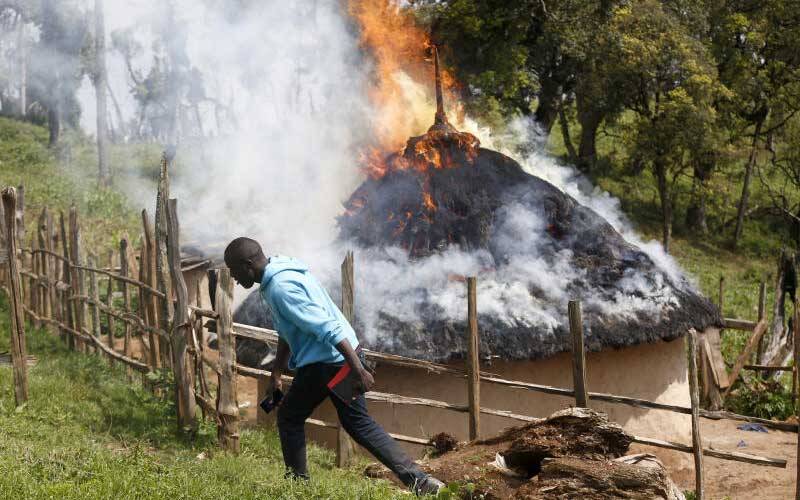
Courtesy of: Standard Newspaper
Unresolved Voices: The Scars of Mau Forest
A History of Dispossession
The Mau Forest was once a sanctuary — a place where the Ogiek and other forest-dependent communities lived in harmony with nature. Colonial land policies disrupted this balance, and post-independence governments deepened the wound. Titles were issued to elites, later revoked in the name of conservation. Families who had lived in the forest “from time immemorial” suddenly found themselves branded as squatters.
The Human Toll
Displacement came suddenly and violently. “We woke up to bulldozers and armed men. Our houses were flattened. We carried our children and whatever we could salvage, and walked into uncertainty,” recalls one victim. Elderly survivors speak of nights spent in the cold, children coughing from smoke and exposure. Some perished, others developed chronic illnesses that remain untreated. Cultural wounds cut just as deep: “Our shrines were destroyed. We cannot bury our dead where our ancestors rest. It feels like our identity was uprooted with the trees.”
Generational pain continues. Young adults born in makeshift camps now raise their own children in the same cycle of landlessness, with no inheritance beyond trauma.
Government Promises — Still Hanging
Successive governments pledged resettlement and compensation. Yet, the promises remain largely unfulfilled. “We were told land was waiting for us. We are still waiting,” says a displaced father. Even the Ogiek’s landmark 2017 victory at the African Court of Human and Peoples’ Rights — affirming their rights to the Mau — has stalled in implementation. Political cycles have turned evictions into tools of patronage, resurfacing around elections and leaving communities in limbo.
Waves of Evictions and Broken Promises
The story of Mau Forest victims is not a single event but a series of unresolved chapters. In the 1970s and 1980s, early evictions under conservation drives displaced families and revoked land titles. The 1990s brought settlement schemes that favored politically connected elites, further marginalizing forest dwellers. Between 2004 and 2009, large-scale evictions in East Mau and Maasai Mau uprooted thousands, creating a humanitarian crisis.
The 2010s were marked by government pledges of resettlement and compensation, but victims remained in camps. In 2017, the Ogiek won their case at the African Court, yet implementation stalled. Renewed evictions between 2018 and 2020 deepened trauma, while the 2020s have seen disputes tied to climate finance projects, leaving victims still landless and scarred across generations.
Conservation vs Community
The Mau is Kenya’s largest water tower, feeding rivers and lakes across East Africa. Conservation is vital — but when pursued without justice, it becomes green grabbing, dispossessing the very people who safeguarded the forest for centuries. One elder put it plainly: “We are not against protecting the forest. We are against being erased from it.”
Why It Remains Unresolved
The unresolved nature of the Mau Forest saga lies in the politicization of land, where evictions are tied to power struggles and patronage. Climate finance projects risk perpetuating dispossession if not rights-based, while lingering trauma continues to fuel mistrust of government and institutions.
Community Blog Voice
This is not just history — it is a living wound. The victims of Mau Forest are still here, still waiting, still carrying scars. Their story is one of resilience, but also of betrayal. It is a reminder that conservation without justice is hollow, and promises without action are cruelty.
“We were told we would be resettled. We were told we would be compensated. We are still waiting.”
Call to Action
The unresolved plight of Mau Forest victims demands more than sympathy — it requires accountability. Policymakers must honor court rulings and deliver on promises of resettlement. Activists and civil society must amplify the voices of the displaced. Communities must continue to tell their stories, refusing to let silence bury their pain. And readers — whether local or global — must recognize that the scars of Mau Forest are not just Kenyan, but human.
Justice delayed is justice denied. The time to act is now.
Create Your Own Website With Webador