


"The Changamwe refinery in Mombasa ceased refining in 2013; its storage and distribution infrastructure remains part of Kenya’s fuel-supply network."
Courtesy of : African Mining Market
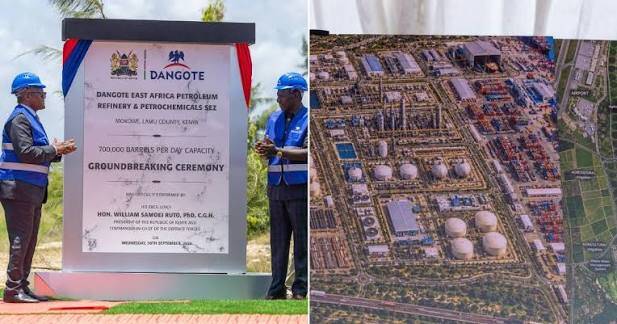
Left: Aliko Dangote, chairman of Dangote Group. Right: President William Ruto at the groundbreaking ceremony for the proposed Dangote East Africa Refinery in Lamu on September 30, 2026. The $16 billion project is planned to process up to 700,000 barrels of crude per day.
Courtesy of: Money254
Kenya’s Energy Crossroads: From Changamwe’s Collapse to Lamu’s Gamble
By: Arap Cheruiyot Adrian Kenduiwo
At the edge of Mombasa’s industrial sprawl, the Changamwe refinery is a monument to a promise Kenya could not keep. Built in the early 1960s, it was meant to give the country control over a strategic link in its fuel supply chain. Instead, its refining units have been idle since 2013, leaving the facility to function mainly as a storage and distribution site.
Thirteen years later, Kenya is being asked to believe in a much bigger version of the same idea: a proposed 700,000-barrel-per-day refinery at Lamu, backed by Aliko Dangote and developed with the Africa Finance Corporation. The project’s supporters describe it as the foundation of an East African refining hub. Its critics should ask a blunter question: what has changed since Changamwe failed?
Changamwe did not simply decay
Changamwe’s decline was not an accident of age. It was the result of a business model that stopped making economic sense, a modernization plan that never materialized, and a public-private partnership that ended in recrimination.
Essar Energy, which acquired a 50 percent stake in Kenya Petroleum Refineries Ltd in 2009, concluded that upgrading the Mombasa refinery was not economically viable in the prevailing refining environment. The company said the facility’s nameplate capacity was about 4 million tonnes annually, but it processed only about 1.6 million tonnes in the year before its exit.
Essar later sold its stake back to the Kenyan government for $5 million, leaving the state with full ownership of an asset that could no longer compete with imported refined fuel. The official record is equally blunt: before its closure in September 2013, KPRL met about 40 percent of Kenya’s petroleum-product requirements.
That history matters because it punctures the easy narrative that Changamwe failed merely because it was old. It failed because Kenya could not make local refining commercially competitive—and because the state and its private partner could not sustain a viable upgrade.
Lamu is not a rescue plan yet
The proposed Dangote East Africa Refinery is not simply Changamwe with better machinery. It is a far larger, more expensive, and more exposed bet.
Planned at 700,000 barrels per day, the Lamu complex would be larger than Dangote’s 650,000-bpd refinery in Nigeria and among the largest refining projects in Africa. Its estimated cost is about $16 billion, and the company has said it intends to finance the project through internally generated cash, bonds, and a planned IPO.
But scale is not the same as viability. Kenya has no established commercial crude production, and the refinery’s proposed feedstock strategy depends heavily on crude from Kenya, Uganda, and South Sudan—markets and supply chains that remain uncertain. Reuters has reported that crude supply is among the project’s central hurdles.
The question is therefore not whether Lamu can process more crude than Changamwe ever could. It is whether there will be enough crude to process, enough buyers for the products, and enough financial and political discipline to keep a $16 billion project operating after the groundbreaking photographs fade.
The pricing promise needs scrutiny
Supporters often imply that local refining will automatically translate into cheaper fuel. It will not—at least not straightforwardly.
Kenya’s pump prices are not set simply by the cost of refining crude. EPRA’s pricing formula includes landed product costs, insurance and freight, processing and distribution costs, margins, taxes, levies, and VAT. Taxes and statutory charges alone account for a substantial share of the final price; recent reporting put taxes and levies at roughly Sh82 per litre of petrol, before retail and wholesale margins.
A refinery may reduce exposure to imported refined-product premiums and improve supply resilience. It cannot abolish global crude prices, freight costs, currency risk, taxation, or the political choices embedded in Kenya’s fuel-price structure.
So the honest question is not, “Will Dangote make fuel cheap?” It is: will the savings from local refining reach consumers, or will they be absorbed by taxes, financing costs, logistics, margins, and weak enforcement?
What must not repeat
Changamwe’s lesson is not that Kenya should never refine oil. It is that Kenya cannot afford another refinery justified by slogans rather than bankable economics.
For Lamu to avoid becoming a larger version of Changamwe, several things must be proven rather than promised:
- A credible, long-term crude-supply plan that does not depend on oil Kenya does not yet produce commercially.
- Confirmed offtake agreements and export logistics, rather than assumptions about regional demand.
- Transparent financing terms, including the extent to which Kenyan taxpayers or state institutions carry contingent risk.
- Environmental, land, fisheries, and community-consent safeguards in Lamu, not merely promises made at a groundbreaking ceremony.
- Regulatory oversight strong enough to ensure that any refining advantage is not captured by intermediaries before it reaches motorists.
Kenya has already lived through the cost of treating a refinery as a symbol of sovereignty while ignoring its economics. Lamu will be judged not by the size of its tanks or the ambition of its investors, but by whether it can survive the same test Changamwe failed.
Add comment
Comments