

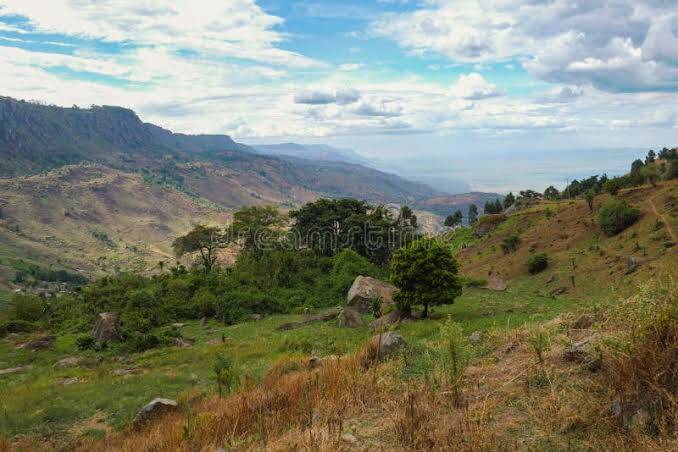
Kerio Valley in Elgeyo Marakwet County, the region the Arror and Kimwarer dams were meant to serve with water, irrigation, and hydropower.
Courtesy: Dreamstime
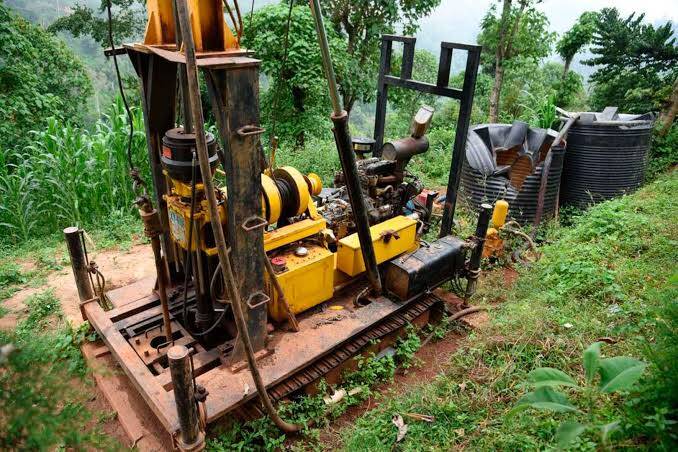
A drilling rig at the Arror dam site in Kipsaiya, Elgeyo Marakwet County. The project was intended to provide water, irrigation, flood control, and hydropower.
Courtesy: Nation Africa
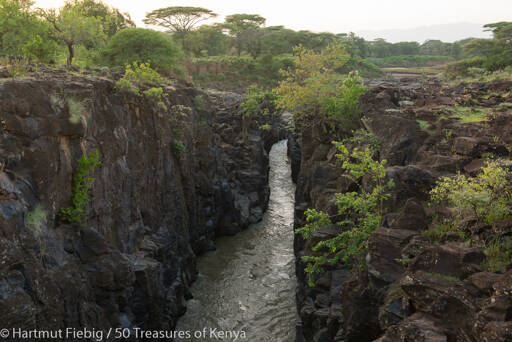
The Kerio River, whose basin was central to the proposed Arror and Kimwarer dam projects. Technical reviewers questioned the feasibility, design, cost, and resettlement implications of the projects in 2019.
Courtesy: Elgeyo Marakwet/WordPress.
Promised Water, Paid for in Billions: The Kerio Valley Families Still Waiting for Arror and Kimwarer
By: Arap Cheruiyot Adrian Kenduiwo
In Kipsaiya, where the Arror Dam was meant to rise, families were told that their land would help bring water, irrigation, jobs, and development to Kerio Valley.
More than 900 families were promised about Sh6 billion in compensation for land they would give up for the Arror and Kimwarer dams. But when the projects stalled, KVDA had received only Sh600 million to begin compensation, leaving many residents unable or unwilling to move.
Years later, the dams remain largely unbuilt. The compensation remains incomplete. And as the government talks again about reviving the projects, residents are asking a question Kenya has not convincingly answered: what happened to the billions—and what happens to the people who were promised a share of the development?
A promise for Kerio Valley
The Arror and Kimwarer dams were conceived as multipurpose projects in Elgeyo Marakwet County, in the Kerio Valley. The Kerio Valley Development Authority (KVDA), a state agency created to develop the region, was the implementing authority.
The dams were meant to do more than store water. They were promoted as solutions for domestic water supply, irrigation, hydropower, and flood control in a semi-arid region where water scarcity shapes daily life and economic opportunity.
The county’s development plan projected that Arror would generate 45 MW and Kimwarer 20 MW, while also providing water for domestic consumption and irrigation.
For residents, that promise carried real weight. A dam could mean water for households and livestock, irrigated farms, construction jobs, and compensation for land or relocation. Those expectations became part of the political case for the projects.
But the dams’ origins were older than the scandal. Proposals for dams in the Kerio basin had circulated for decades, and feasibility work had been discussed long before the contracts that later triggered national controversy.
From idea to contract
By the 2010s, the projects had moved from concept to procurement. KVDA initially pursued the dams with Chinese contractor Sinohydro. After Sinohydro withdrew, KVDA entered into contracts with Italy’s CMC di Ravenna and Itinera.
That change mattered. Under the original arrangement, the contractor was expected to play a greater role in financing. After the Italian firms came in, the government became the borrower for the loan facility—an arrangement that shifted more of the financing risk onto Kenya.
The contracts were signed in the period between 2014 and 2017. CMC di Ravenna, with Itinera, was to undertake engineering, procurement, and construction. Italian and European financial institutions were involved in the financing, with Italian export-credit agency SACE providing insurance cover for the financiers.
On paper, the projects looked transformative. In practice, the contracting structure placed Kenya in a position where large sums could be disbursed before the dams had taken physical shape.
The money question
The figures at the centre of the controversy are stark.
Prosecutors later said the commercial contract priced Kimwarer at about $204 million and Arror at about $252 million—approximately $456 million, or about Sh46 billion. They alleged that Treasury negotiations increased the financing package to about Sh63 billion, an increase of roughly Sh17 billion.
The Sh63 billion figure became the shorthand for the scandal. But it is important to be precise: it referred to the overall value of the contested financing arrangement, not necessarily cash physically stolen or construction completed.
The Auditor-General’s audit of KVDA for 2017/18 recorded a Sh4.29 billion advance payment for Arror on December 7, 2017. The report described it as 15 percent of the contract sum.
The same audit recorded a Sh3.49 billion advance for Kimwarer on September 27, 2018, for mobilisation and design.
By the 2019/20 audit, KVDA’s financial statements reflected Sh7.78 billion in advance payments for the multipurpose projects. The Auditor-General reported that the advances had not been recovered through certified works and that physical verification found the contractor was not on site.
That became one of the central questions: if billions had been advanced, what had Kenya received in return?
Advance payments under scrutiny
Advance payments are not inherently illegal. Contractors often require mobilisation money to procure equipment, mobilise staff, and begin design or preliminary works.
The issue was whether Kenya’s payments were properly supported.
The Auditor-General questioned the Sh4.2 billion advance paid for Arror. According to reporting on the audit, the claim certificate was undated, had not been recommended by KVDA’s technical-services office, and lacked approval by the KVDA managing director.
The audit therefore did not merely ask whether money had been paid. It asked whether the payment had followed the required internal controls and whether the contractor had provided the deliverables justifying the disbursement.
There were also questions about where some Kimwarer-related funds went. Reporting on the Auditor-General’s findings said Sh3.7 billion in Kimwarer cash never entered KVDA accounts, raising concerns that the money may have been deposited in private accounts.
Those findings did not, by themselves, establish criminal guilt. But they gave investigators a financial trail worth pursuing: payments made, approvals questioned, works not verified, and public money potentially outside the implementing agency’s direct control.
Technical doubts emerge
While the money was moving, questions were also growing about whether the dams were technically and financially viable.
In 2019, President Uhuru Kenyatta appointed a technical committee to review the projects. Its report was submitted on September 18, 2019.
The committee’s findings were damaging. The parliamentary record states that the committee found a lack of technical design and feasibility study, a fault line in the project area, high resettlement and compensation costs, unsustainable operating costs, and overpricing.
The committee recommended cancellation of the Kimwarer project and scaling down of Arror.
That recommendation exposed a central contradiction: Kenya had already committed substantial public money to projects whose technical and financial foundations were now being questioned.
The cancellation
On September 18, 2019, President Kenyatta ordered the cancellation of the Sh22.2 billion Kimwarer Dam project. The government said the project was neither technically nor financially viable.
The president also directed that the Arror project be redesigned and retendered.
The cancellation did not mean Kenya walked away without consequences. By then, reporting indicated that about Sh22 billion had already been committed or paid under the contracts.
The cancellation also created a new problem: contractual disputes with the Italian contractors. The contractors argued that Kenya had terminated the agreements improperly, while Kenya argued that the projects were flawed and that public money had been exposed to serious risk.
The criminal case
In July 2019, former Treasury Cabinet Secretary Henry Rotich, former Principal Secretary Kamau Thugge, former KVDA managing director David Kimosop, and others were arrested and charged over the dams.
The charges included conspiracy to defraud and abuse of office. Prosecutors alleged that the contracts, financing arrangements, and payments had been structured in ways that exposed Kenya to losses.
The case became one of Kenya’s most closely watched corruption prosecutions because it involved senior Treasury officials, a state development authority, foreign contractors, and a multibillion-shilling borrowing programme.
But the prosecution’s case did not go as planned.
Why the case collapsed
On December 14, 2023, the Anti-Corruption Court acquitted Rotich and eight co-accused.
The acquittal followed the prosecution’s failure to present 41 of the 49 witnesses it had listed. The prosecution called only eight witnesses, most of them from KVDA.
The court found that the evidence presented was insufficient to sustain the charges.
That ruling was significant—but it must be understood accurately. The acquittal did not find that the dams were properly delivered, that the contracts were sound, or that no public money was lost. It found that the prosecution had not proved its case against the accused persons on the evidence actually presented.
For critics, the collapse of the case became evidence of institutional failure. For the accused, it was vindication of their assertion that the prosecution had not established criminal wrongdoing.
The fight over prosecutors
The acquittal did not end the controversy.
In 2024, civil-society groups including Transparency International Kenya, Katiba Institute, the Kenya Human Rights Commission, and AfriCOG filed a petition seeking to hold prosecutors personally liable for the collapse of the case.
They argued that the prosecution’s failure to call 41 witnesses amounted to a failure to pursue the public interest.
In November 2026, the High Court dismissed the petition. Justice Chacha Mwita found no evidence that the prosecutors acted unlawfully, in bad faith, or with improper motives.
The court accepted that the prosecution had cited withdrawn witnesses and the absence of a substantive Director of Public Prosecutions when seeking adjournments.
The ruling protected the prosecutors’ good-faith immunity. It did not erase the broader public concern: a Sh63 billion controversy had produced no criminal conviction, while the underlying projects remained unresolved.
The debt did not disappear
Cancelling the contracts did not cancel Kenya’s financial exposure.
Reporting in 2022 indicated that Kenya had defaulted on about Sh5 billion in Arror and Kimwarer-related loans.
In 2023, Kenya and Italy agreed to renegotiate Sh19.8 billion in loans connected to the dams.
The renegotiation was part of a broader effort to resolve the legal and financial standoff created by the cancellation.
By 2026, reporting indicated that Kenya continued paying Sh23 billion in loans that had already been taken from project financiers and disbursed to the contractor, even though the contractor later filed for bankruptcy.
That is the uncomfortable financial reality: the dams were not built as planned, but the borrowing and repayment obligations did not simply vanish.
Arbitration and settlement
The cancellation also triggered arbitration.
Italian contractors sought compensation for work not done, with reporting indicating a claim of more than Sh11 billion.
In March 2023, Kenya’s Cabinet approved an alternative dispute resolution process and authorised the Treasury to negotiate a commercial settlement with the Italian contractors.
The settlement approach reflected a political decision: rather than continue fighting the contractors in arbitration, Kenya would negotiate a way forward.
That decision reopened the question of whether the dams would ever be built.
Ruto’s revival push
President William Ruto made revival of the projects part of his engagement with Italy.
In March 2023, Ruto met Italian President Sergio Mattarella and announced that Kenya and Italy had agreed on the resumption of the stalled projects.
KVDA board chair Mark Chesergon later said the authority was developing an implementation roadmap for the dams. He said the Cabinet had approved a settlement agreement for their resumption.
But the revival was not immediate. In April 2026, reporting from Ruto’s visit to Rome said construction of Itare and Arror was set to resume, while Kimwarer remained delayed because of unresolved technical issues.
The distinction matters. A political announcement of revival is not the same as construction beginning. As of late 2026, the physical sites remained largely undeveloped, and the government was still working through administrative and contractual hurdles.
What residents were told
For communities in Kerio Valley, the dams were not an abstract policy debate.
They were promises of water, irrigation, jobs, compensation, and development.
Those promises became more urgent as drought and water scarcity continued to affect the region. The dams were presented as a solution to problems residents had lived with for generations.
But the scandal left many of those expectations unmet. The projects were cancelled, delayed, or caught in legal disputes, while residents waited for clarity on compensation, resettlement, and implementation.
That human cost is often missing from the financial headlines. Yet it is central to the story: public money was committed in the name of development, while the people the project was meant to serve were left waiting.
What the record shows
The Arror and Kimwarer story is not a simple tale of money stolen and dams never built.
It is a more complicated story of:
- A legitimate development need in Kerio Valley.
- A contracting and financing structure that shifted risk to Kenya.
- Large advance payments made before construction was verified.
- Audit findings questioning approvals, certificates, and recoverability of advances.
- Technical reviewers questioning viability and cost.
- A presidential cancellation that created contractual and arbitration exposure.
- A criminal prosecution that collapsed after prosecutors called only eight of 49 witnesses.
- A revival effort that remains incomplete and uncertain.
The unanswered questions
Several questions remain unresolved.
- Who approved the original contracts and financing structure?
- Why were large advances released before verifiable construction milestones?
- What exactly did the contractors deliver for the money already paid?
- Why did the prosecution fail to call 41 witnesses?
- How much of the debt has Kenya repaid, restructured, or written off?
- What will the revised projects cost, and who will bear the risk?
- Will residents receive the compensation and benefits they were originally promised?
Until those questions are answered with documents, testimony, and independent verification, the Arror and Kimwarer dams will remain what they have become: a cautionary tale about the gap between Kenya’s development ambitions and its ability to deliver them without leakage, delay, or impunity.
A cautionary tale
The Arror and Kimwarer dams were meant to transform Kerio Valley.
Instead, they became a case study in how a development project can become a financial and political liability.
The dams remain largely unbuilt. The debt remains live. The criminal case ended without conviction. And the people of Kerio Valley are still waiting for the water, irrigation, and development they were promised.
That is the real story behind Arror and Kimwarer: not just a scandal, but a failure of public procurement, financial oversight, technical planning, and accountability.
Add comment
Comments